|



Greetings from London in the springtime, where I have been mostly been hiding in my book writing cave.
Below are all the usual reading and distractions, along with a few things i’ve been up to, including a new piece in Foreign Affairs, this time on an idea for India that most people thought was a bit nuts.
Enjoy the weekend!
James
ps - My new aim is to do these notes a bit more often now, hopefully once a fortnight at least. Let’s see if i manage it.
 |
This is a dispiritingly occasional private mail for friends and family, with reading recommendations and other things that catch my eye. Feel free to unsubscribe below, if you’d rather not. If it was forwarded on to you, by all means click the blue button for more.

What Hilary Mantel Could Teach Donald Trump
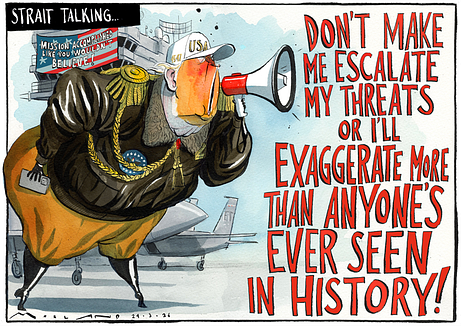 |
Rereading Wolf Hall on Iran. Having been re-reading the book again, I’ve been meaning to write about what it might teach us about Trump and neo-monarchism. I’ll come back to that later. But as Iran deteriorates, a passage from Mantel lodged in my head.
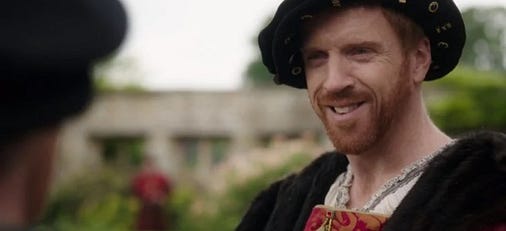 |
On impulsive kings and unwise wars. Early in the book, Cromwell meets Henry for the first time. (You can see the scene in the TV series, with a recap here.) Henry asks about a remark Cromwell made in Parliament six years earlier, suggesting England couldn’t afford a war.
“It was seven years: 1523. ... There’s no point backing off; do that and Henry will chase you down. Advance, and he may just falter.
He says, “No ruler in the history of the world has ever been able to afford a war. They’re not affordable things. No prince ever says, ‘This is my budget; so this is the kind of war I can have.’ You enter into one and it uses up all the money you’ve got, and then it breaks you and bankrupts you.”
Trump’s Iran mission creep. The passage feels of the moment, not because Iran is literally unaffordable, but because wars escalate, becoming far more costly. Trump assumed a best-case outcome when he launched Operation Epic Fury, namely a quick Venezuela-style change in leadership. He is now stuck.
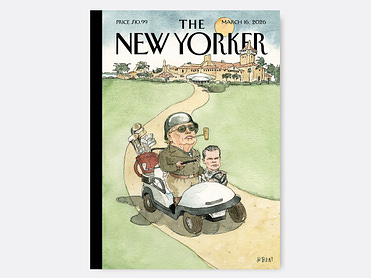 |
No good options. Backing down is the easiest path, but it’s humiliating. Worse, it would leave Iran with the demonstrated capacity to close the Strait of Hormuz. This is unacceptable both to Washington and its Gulf allies. Escalating further, on the other hand, is hugely risky. Israel favours it. The Gulf states are edging in that direction , at least in their public posture. But anything that involves ground troops carries obvious risks of casualties, and an ensuing bloody quagmire.
Making it up as we go. I was on a call last week with a very senior ex American military leader, who had been involved in Iran war planning earlier in his career. He said that traditional US war plans for an Iran scenario like this did not involve sustained use of ground forces, because it would be obviously nuts. He took away from this that Trump and his team are making up these options as they go along, as they try to find a credible “escalate to de-escalate” threat to bring the conflict to an end.
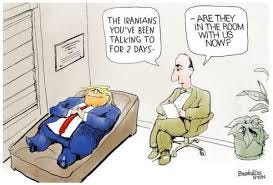 |
Always with the escalation dominance. Part of Trump’s problem is a deep psychological commitment to what strategists call “escalation dominance.” If someone threatens to punch you, you punch them first and harder. Demonstrate that you’re willing to go further than the other side, and they’ll back down.
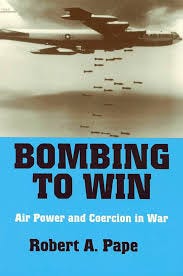 |
The problems with air power. There was a good piece on all this in Foreign Affairs recently, by Robert Pape, a political scientist at the University of Chicago and author of Bombing to Win: Air Power and Coercion in War. Pape’s book shows bombing campaigns almost never compel governments to capitulate. His argument titled bluntly Why Escalation Favors Iran, is that Iran is sensibly deploying a strategy often used by weaker powers.
“They represent a strategy of horizontal escalation, a bid to transform the stakes of a conflict by widening its scope and extending its duration. Such a strategy allows a weaker combatant to alter the calculus of a more powerful foe. And it has worked in the past, to the detriment of the United States. In Vietnam and Serbia, U.S. adversaries responded to overwhelming displays of American airpower with horizontal escalation, eventually leading to American defeat, in the former case, and, in the latter, frustrating U.S. war aims and spurring the worst episode of ethnic cleansing in Europe since World War II.”
Iran’s partial closure of the Strait of Hormuz was an obvious example. As Pape explains:
“Horizontal escalation occurs when a state widens the geographic and political scope of a conflict rather than intensifying it vertically in a single theater. It is especially appealing as a strategy for the weaker parties in a military contest. Instead of trying to defeat a stronger adversary head-on, the weaker side multiplies arenas of risk—drawing additional states, economic sectors, and domestic publics into the remit of the conflict. Iran cannot defeat the United States or Israel in a conventional military contest. It does not need to. Its objective is to gain greater political leverage.”
Pape’s subheading — “America and Israel May Have Bitten Off More Than They Can Chew” — captures his conclusion. Trump now faces a dilemma with no clean exit:
“Trump is thus on the horns of a dilemma, having to judge whether Washington should deal with short but limited political costs now or more protracted and more uncertain political costs later. There is no golden off-ramp, one that increases the political benefits for Washington. Every option now carries political costs and risks; the initial strike may have solved a tactical problem, but it created a strategic one. Given these realities, the wisest choice may well be for the United States to accept a limited loss now rather than risk compounding losses later.”
 |
Don’t tell a King he can’t have a war. Pape’s advice seems right to me, but it is exactly the kind of advice rulers don’t like. Trump wants an option where he can be seen to win, just like Henry didn’t like when Cromwell told him he should avoid battle altogether. This favors rolling the dice.
*”You said I was not to lead my troops. You said if I was taken, the country couldn’t put up the ransom. So what do you want? You want a king who doesn’t fight? You want me to huddle indoors like a sick girl?”*
*”That would be ideal, for fiscal purposes.”*
Advisors to princes can counsel caution but it seems unlikely they will listen. Trump has spent his political career betting that doubling down works. It often has, for him at least. My best guess is that he does so again here.
5 essays worth reading
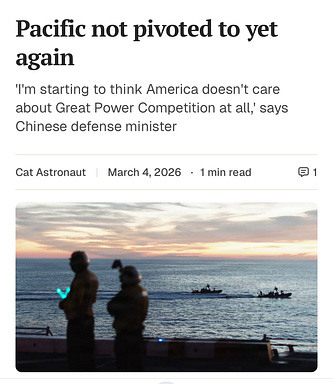 |
Asia After America. Zack Cooper, one of the best Indo-Pacific hands in DC, in Foreign Affairs on pivot RIP. One sliver of hope: Chinese overconfidence. Those of us racing to finish books on related subjects take note. See also this darkly comic companion piece in Duffleblog, from the screen grab above. (PDF)
As the United States curtails its economic and political engagement, it faces the prospect that China could pick off U.S. allies and partners one by one. Many of these countries are already rethinking their alignment decisions and concluding that Beijing may be a more appealing partner—or an inevitable regional hegemon. As a result, any U.S. strategy that focuses primarily on the military defense of a handful of countries on the first island chain may not be sustainable. But the better option—a comprehensive pivot—is now a practical impossibility. What is left is a strategy based on shoring up a defensive line that might not hold forever but could contain Chinese expansion for now. If executed well, such a strategy could buy enough time for missteps by China to create new openings for the United States and its allies and partners in Asia. Chinese regional dominance is by no means assured. Beijing is increasingly overconfident and is likely to overplay its hand. Still, Chinese leaders are now the ones with the cards to play. The pivot was meant to anchor U.S. leadership in Asia; its unraveling could leave China to set the rules.
The Front-Runner. Helen Lewis brilliant as ever in The Atlantic on the man who may end up being the Democrats’ best shot at 2028, but also a deeply flawed and complicated one.
As for his liabilities, well, the word smarm comes up a lot: The teeth are too white, the hair perfectly gelled. As if to compensate for his overuse of buzzwords—he told me he was “concerned about the significant expansion in the health-care space from a sustainability perspective”— man and brother are strategically deployed to seem folksy. In person, he is enormously charismatic, and is obviously performing. “He is a good communicator,” the Bay Area political strategist Alex Clemens told me. “He tries very hard to be a good communicator, and some people latch on to the trying-hard, instead of the end result.”
Prisoner number 804: the plot to erase Imran Khan. Delightfully-written on Pakistan’s most famous inmate, by Osman Samiuddin. Originally in Equator, a new publication worthy of your time, then re-printed outside the paywall in the Guardian.
An authoritarian government trying to vanish a popular political leader is hardly an unfamiliar tale. But it is a tall order in a digital age – and taller still when that leader happens to be the country’s most famous person, with a fame that long predates their political career…. over 50 years he has become ubiquitous, but also, in a way, omnipresent. Not only has Imran been a tangible presence – held in our hands, framed on our walls, boxed in on our TVs and scrolled down our devices – he has also been an incorporeal one, in our idolisation and aspiration, in our lust and disgust, our adoration and our grudges, in our prayers and curses. So no, he can’t simply be wiped away. And yet, last November, he vanished so completely that it was reasonable to wonder if he had died, until one of his sisters was finally allowed to see him
Jürgen Habermas’ Lost World. Thoughtful obituary-as-intellectual-history in Engelsberg Ideas, paying tribute to the greatest German philosopher of the modern era, who died recently at 96. It focuses on his most celebrated argument: that coffee-houses in northern Europe launched a genuinely new “public sphere” in which citizens reasoned collectively regardless of rank.
“The historical core of Habermas’s most influential work takes the London of the late 17th and early 18th centuries as its paradigmatic case: the coffee-houses, the periodical press, the gentlemen’s clubs. Habermas’ argument focuses on a specific constitutional moment. When Parliament allowed the 1662 Licensing Act to lapse in 1695, it removed the apparatus of pre-publication censorship and broke the Stationers’ monopoly over the book trade. What followed was a transformation in the conditions of public discourse. Publication rates surged. Hacks multiplied. The number of periodical issues quadrupled within a generation, creating a veritable ‘Republic of Letters’.... It was from this culture, Habermas argued, that something genuinely new emerged: a sphere of private people come together as a public body, reasoning collectively about matters of common concern, and, in doing so, exerting a pressure on the authorities that no previous arrangement had permitted.”
Stay Classy. Andrew O’Hagan in the London Review of Books reviews two new works on the dissolute House of York — one on Andrew and Fergie’s decades of avarice, the other on Virginia Giuffre’s posthumously published memoir. Withering would be to put it mildly.
Years ago, before it was fashionable, some of the youngsters in the family were calling Andrew ‘the Nonce’, and there was general dismay at the Yorks’ reckless avarice. The British royal fantasy has a few sustaining mythologies, and one of them is dignity, a quality defined, after Andy and Fergie, more by its absence. The late queen can be held responsible for much, but nobody could accuse her of seeming to enjoy her role. For the Yorks, however, enjoyment was everything, and the notion of royal sacrifice, arguably a red herring in the House of Saxe-Coburg and Gotha, was finally obliterated by their actions. The writing was on the wall, or on the T-shirt, when Sarah Ferguson appeared in the mid-1980s wearing one that said ‘Piste Again’. The duchess loved skiing and being on holiday and Andrew was addicted to having everything for free. What to do? Eventually, Andrew Lownie records, they were lent King Hussein of Jordan’s seven-bedroomed Castlewood House on the edge of Windsor Great Park. ‘Bored, Sarah started 1987 with three weeks at Sandringham, followed by a fortnight skiing in Klosters, and a ten-day break with Andrew in Barbados paid for by the multi-millionaire Robert Sangster.’ At this point, Sangster had been a tax exile for twelve years. Stay classy.
6 things that caught my eye
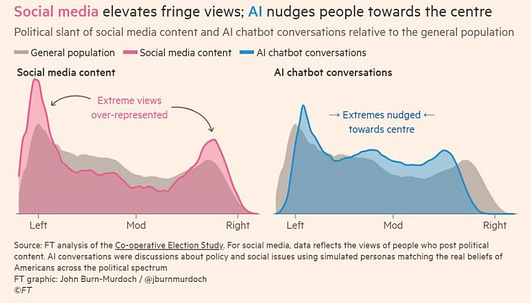 |
AI might save democracy. Important piece by John Burn Murdoch in the FT, on the possible democratic impact of technologies throughout history. AI models, unlike social media, may actually be a boon for social consensus and democracy. (Gift Link).
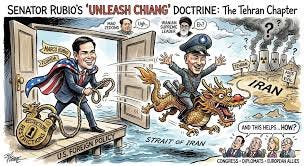 |
Unleash Chiang! Rubio recently unleashed a phrase long favoured by the Bush family, about Chiang Kai-Shek. The origin is weirdly fascinating, so i did a post on LinkedIn.
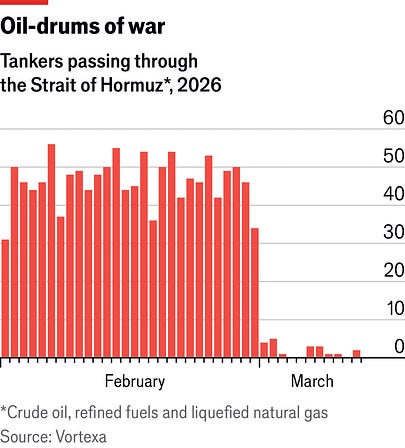 |
Tanking. Traffic through the Strait of Hormuz — averaging around 45 a day through February — has flatlined. (Hat tip: The Economist)
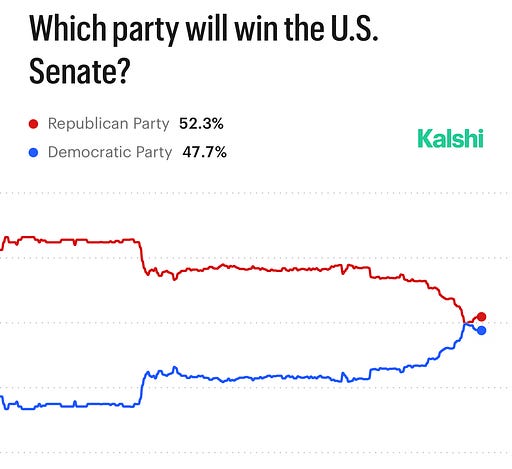 |
Yes, yes, we know what it looks like. Still, post-Iran prediction markets have moved from 75% Republican just weeks ago to pretty much dead even. (Hat tip: Kalshi)
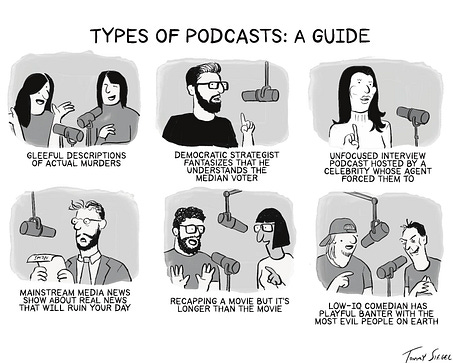
Every podcast you’ve ever listened to. Tommy Siegel’s excellent cartoon taxonomy. (Hat tip: Siegel via Threads)
The British constitution, as God intended. Elijah Granet’s flowchart of British constitutional checks and balances — featuring Almighty God, the King of the Netherlands, and the Pope. Somehow also clarifying. (Hat tip: @legalstyleblog via X)
What I’ve been up to
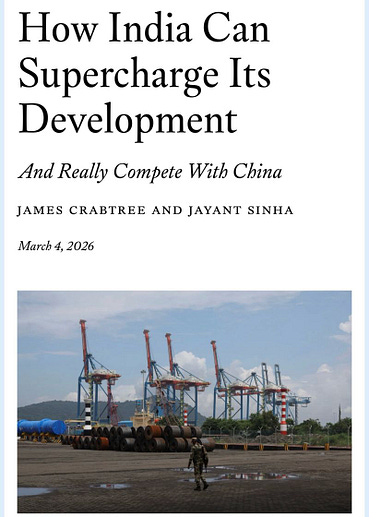 |
Writing on India and the CPTPP. A new essay in Foreign Affairs with former economic minister Jayant Sinha, on why India should join the world’s most important trade deal. More here on LinkedIn, and gift link to read the piece here.
A short piece on Australia and Europe for ECFR. They signed a bonza trade deal last week, and more besides.

Visiting Condy in California. I spent a few days hanging out with security hawks at Hoover and AI people in Mountain View. I’ll write more about the second soon.
Plotting a visit to Boston. I’ll be in Cambridge for the first in forever in mid-May, if any of you happen to be there.
Finishing a book. It’s very nearly done. Update soon.
ps — I still do excellent talks. Also good at moderating events. Drop me a line.
Thanks for reading. If this was forwarded to you, and you’d like to get it in future, feel free to click the blue button. You can also add me on LinkedIn.
Thanks for reading James Crabtree! Subscribe for free to receive new posts and support my work.
| |||||||

