
|


Where do we even begin? If we have to explain this week’s rally, it cannot be pinned on a single event, rather, it was the culmination of a series of developments we were already aware of, but had assigned a very low probability to. Today that probability is 100%, 100% chaos and confusion. Let’s go in chronological order.
Strait of Hormuz
Following last week’s attacks on tankers, traffic through the Strait has effectively come to a standstill. The market believes one or two Sinokor vessels are still making the crossing each day, but nothing from Iraq, Kuwait, or Saudi Arabia, only a trickle of UAE exports, and no meaningful improvement is expected anytime soon. Everything now depends on the willingness of shipowners to send vessels into the Gulf, and more importantly on insurers, who have withdrawn virtually all war risk coverage, even at absurd premiums approaching 15%. Every voyage is now negotiated on a case by case basis.
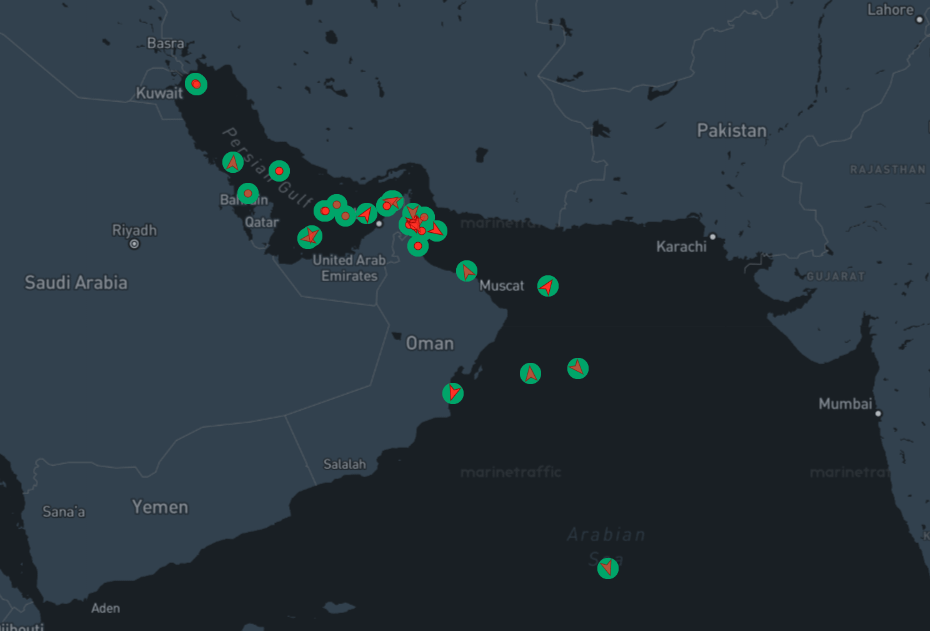 |
Sinokor continues to maintain a presence in the area. Only the ROTTERDAM ENERGY departed this week, along with the NEW GIANT from Iraq and a Dynacom Panamax that was going in on Monday. Beyond that, it has become almost impossible to confirm vessel movements as all backchannels have gone silent. Curiously, despite the “US naval blockade”, Iranian vessels are trickling in.
The clearest evidence that cargoes are missing can be seen in the Murban and Oman versus Dubai differential. We have gone from roughly ten STS operations in the Gulf of Oman to fewer than three observable on Wednesday. Once again, exports have fallen back to around 1.5 Mnbpd FOB Fujairah and 0.9 Mnbpd from Oman, plus whatever limited volumes still manage to escape through the Strait. Needless to say, inquiries for cargoes loading inside the Gulf have gone missing.
Black Sea
The story is much the same, and once again, the shipowners are dictating the terms, demanding an additional risk premium, and while owners and charterers negotiate, the market has effectively frozen. There was not a single fixture concluded this week.
CPC Terminal and the port of Novorossiysk have only around 15 million barrels of workable storage capacity, almost nothing. If vessels are unable to load, the pipeline system quickly backs up and production has to be curtailed, exactly what happened this week. Some reports suggest Kazakhstan’s production has fallen below 1 Mnbpd, compared with 1.8 Mnbpd just a week ago. This disruption primarily affects Meds refiners, thus making it a direct link to the Brent complex.
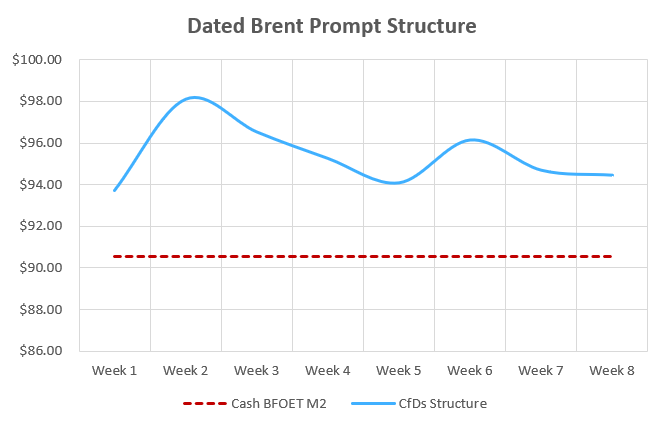 |
Next week the Meds will be short at least 8 million barrels, and that shortage is already visible in the CFD curve from the second week onward. The overhangs that had been weighing on next week’s window (those BP cargoes) were absorbed almost immediately, and the North Sea has gone from a modest surplus to a severe deficit in just a matter of days.
CPC is expected to resume operations on Sunday or early next week, but the damage has already been done. There are simply no replacement barrels available. Not even Arab Light, now being offered out of Egypt, can fully compensate, different qualities. WAF is 20 days away. WTI is 20 days away. Brazil and Guyana 15 days away. The only way to plug the hole is to pry barrels away from someone who had already secured them for those dates. Who ended up short? Exxon.
Exxon relies on equity barrels from CPC to supply its French refinery. When those barrels disappeared, they had no choice but to step into the spot market and pay up. That is how we ended up with “Dated +5”. Pure supply and demand.
Bab al Mandeb
Very few people took the previous threats seriously, until two Saudi vessels were hit. The Houthis pioneered this model of hybrid warfare where civilian shipping becomes a legitimate military target, we should have taken them more seriously.
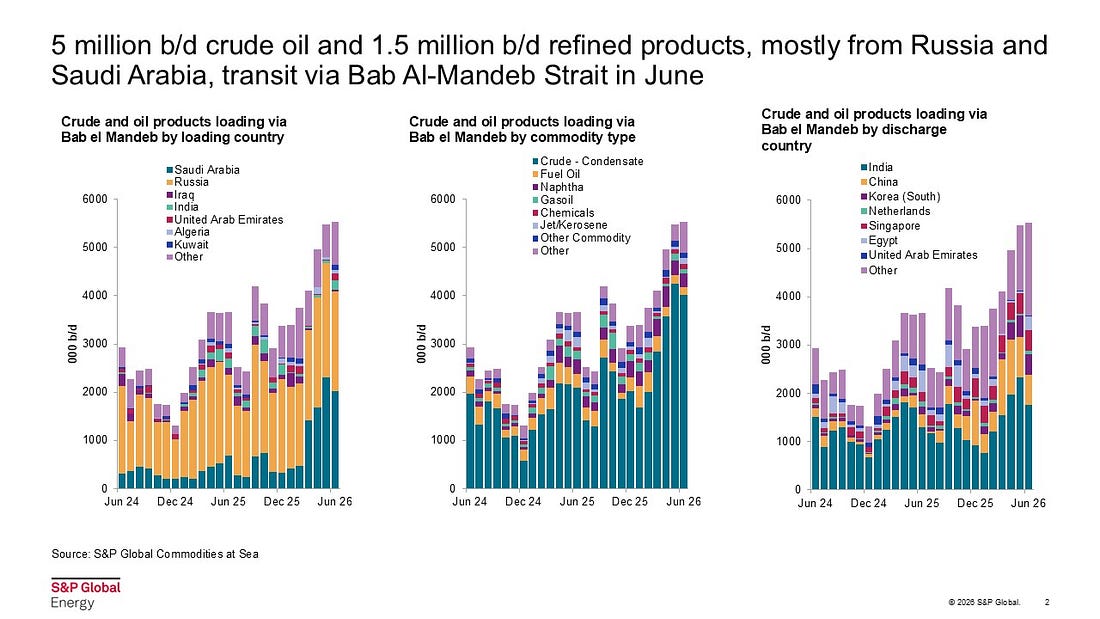 |
The port of Yanbu remains Saudi Arabia’s only viable export outlet, currently averaging around 4Mnbpd. Of those volumes, 2 goes to China, 1.5 is split between South Korea and Japan, and the rest goes to India.
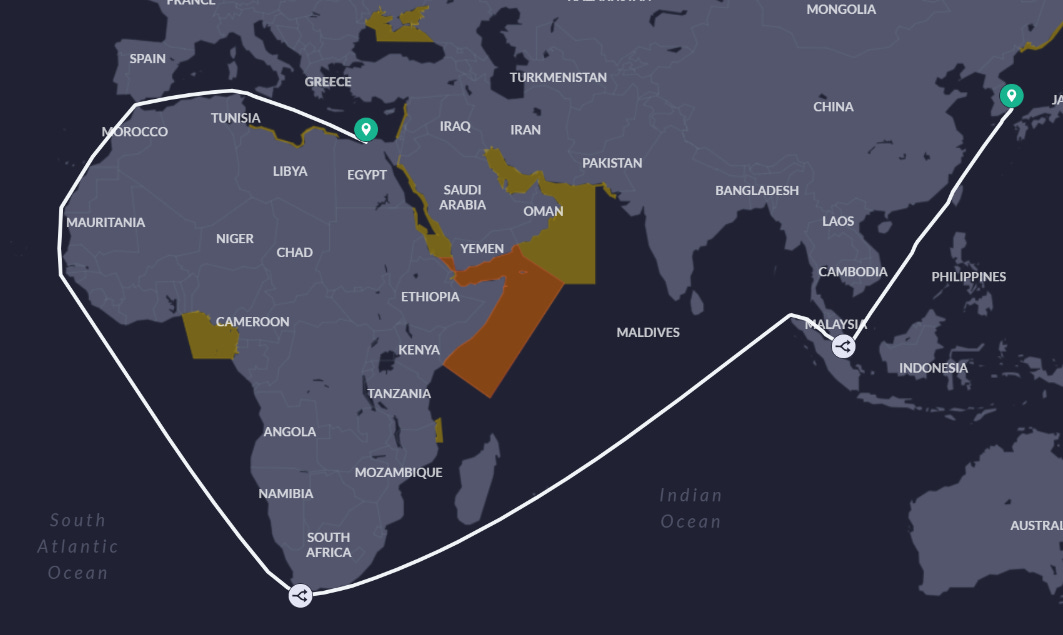
But is this really a blockade? Is it aimed exclusively at Saudi Arabia? Much has been lost in the translation, but over the past two days a pattern has started to emerge. China appears to have free passage, as demonstrated by two Chinese VLCCs loaded with Arab Light that successfully transited the Strait. South Korea and Japan, meanwhile, have increasingly opted for the Suez Canal route, (DHT Mustang), India has a different concern altogether, the 2.5 Mnbpd of Russian crude arriving from the Baltic and the Black Sea, and for now that flow remains uninterrupted as Russian vessels do as they please (they always have).
 |
So let’s take an intelectual shortcut assume the real issue are those 1.5 Mnbpd and the fleet of 63 Saudi flagged tankers.
Bahri’s VLCC fleet is already scattered across Asia, with only one vessel remaining in the Red Sea, which could still exit through the northern route. COSCO (China) could easily arrange a straightforward swap with Bahri, allowing Chinese vessels to position Saudi cargoes while Bahri takes over COSCO’s cargoes elsewhere. Operationally, this is not particularly complicated, just two back to back time charters.
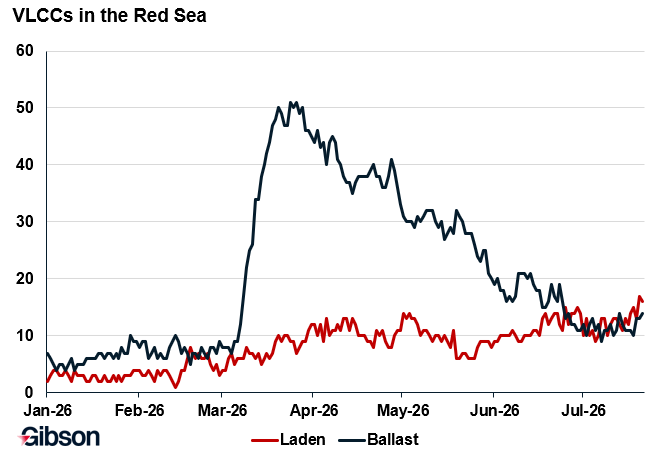 |
The challenge lies with everyone else lifting cargoes from Yanbu. Their alternative is routing via the Suez Canal, adding roughly 25 days and around $3/bbl in transportation costs. That may not sound dramatic, but freight from Yanbu to China via Bab al Mandab already stands near $6/bbl, so the detour effectively increases transportation costs by 50%. Who pays for that?
A fully laden VLCC can technically transit the Suez Canal, but only after partially discharging because of the canal’s maximum draft restriction of 20.1 meters. While that is close to the regular draft of a VLCC carrying 280k tonnes, operators still require at least 3 meters of under keel clearance. In practice, vessels discharge part of the cargo at Ain Sokhna, connect into the SUMED pipeline, and then reload at the other side. Much has been said about SUMED’s nominal capacity of 2.5 Mnbpd, which is more than sufficient to handle these volumes, but the bottleneck is Sidi Kerir, Egypt’s reload terminal, which has rarely handled more than 400/500kbd.
That leaves a 1.5 Mnbpd gap lasting roughly twenty five days, and the only barrels capable of reaching South Korea or Japan before August 20th are the ones currently leaving the Gulf of Oman. There is really only one player that can afford to resell cargoes in Asia….. you guess it, China, and it has already resold a few Murbans that got out just last week.
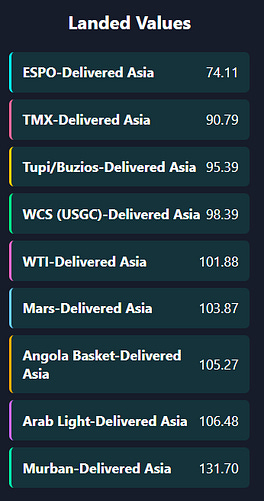
Atlantic Basin crudes have all seen stronger demand, but this is less about outright shortages than about diversifying Middle East exposure and improving October and November arbitrage economics.
 |
The CPC disruption appears temporary. The Houthi situation has a workaround, albeit one that will be painful for the next 25 days. The real concern remains Hormuz, where there is still no visible path toward de escalation.
That said, as of the time of writing, there are growing rumors that China may assume a much more active role in negotiations. Coincidence?? the Houthis could be a threat to Chinese interests more than Hormuz itself. And if you connect the dots, first Hormuz, then Bab al Mandab...next shoe to drop is Malacca and that’s where things get hairy for them. This stops here...
Subscribe to Oil not dead to unlock the rest.
Become a paying subscriber of Oil not dead to get access to this post and other subscriber-only content.
A subscription gets you:
| Oil Weekly Commentary | |
| A custom App and chat | |
| We might start doing webinars |
| ||||||||||


