
|


After falling nearly 20% in just three trading sessions, crude found its footing in the high $80s as the July Brent contract expires. Throughout July, Brent traded within a remarkable ~$33 range as the conflict with Iran swung back and forth between diplomacy and bombs, finally settling in the “bombs” camp…
 |
That said, I would argue the this week marked a meaningful reassessment of risk and reward. With every participant struggling to keep up with the growing number of geopolitical flashpoints, the market has become noticeably more risk averse in the physical front. The prevailing view now is that this time there will be no “Daddy Government” coming to the rescue. If we need barrels, we will have to fetch them ourselves.
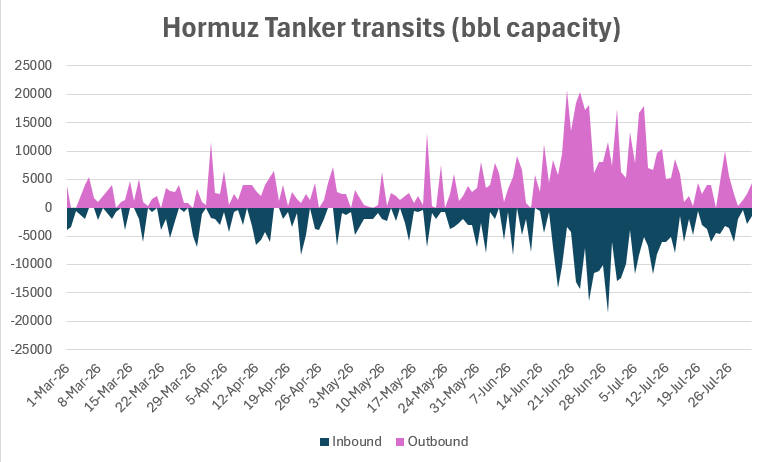 |
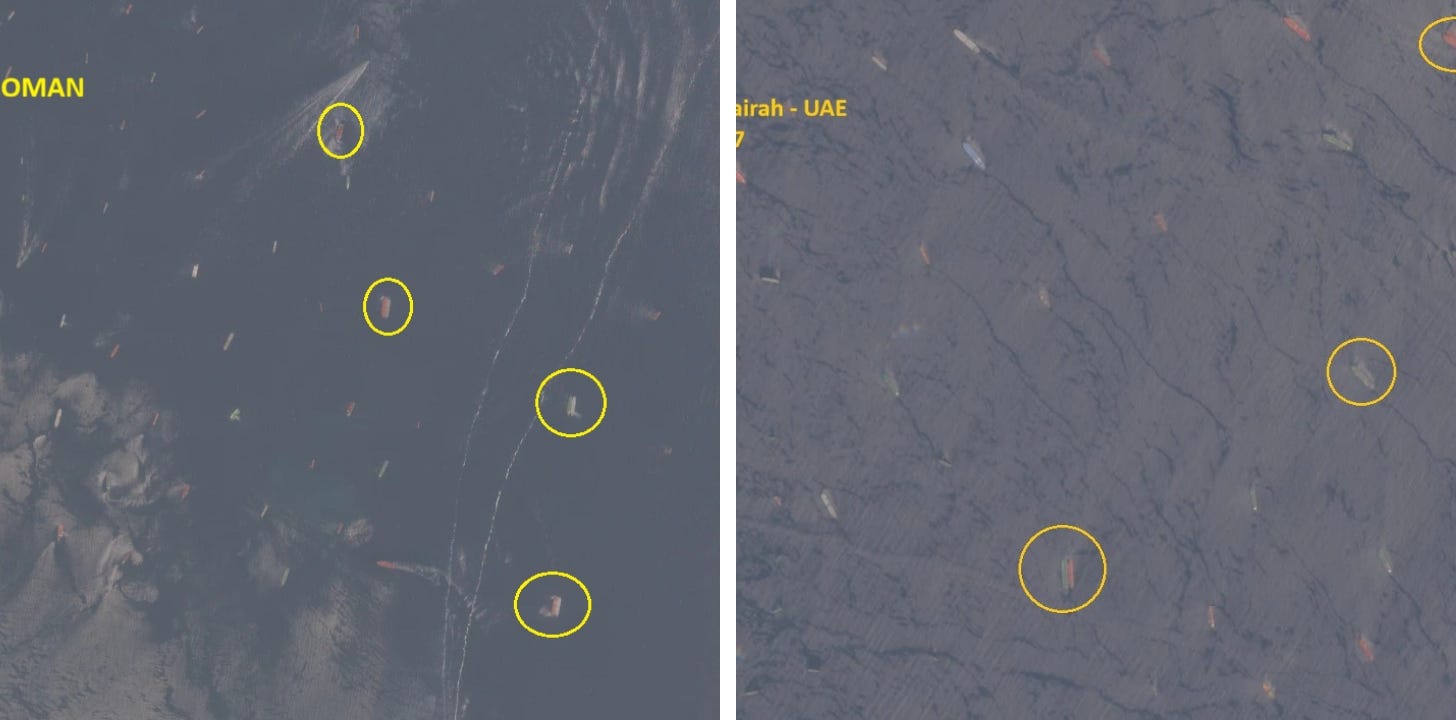
The prevailing mood across the oil community is “as long as they’re busy shooting at each other, they won’t be hitting the ships”. The market is effectively betting that these bastards will run out of ammo before we run out of barrels (It also helps that most of the compliance people are on holiday). That growing confidence is already becoming visible in the gradual increase in tanker traffic through the Strait of Hormuz, and now we can say there are more STS operations taking place in the Gulf of Oman.
The other chokepoint is proving more difficult to assess, maybe it is still too early to know what the new trade flows will ultimately look like. For now, volumes appear to be split roughly fifty fifty between the Suez Canal and the Houthi’s alley. Yanbu, meanwhile, continues to operate at only half capacity, around 2 Mnbpd, simply because there are not enough ballast vessels available.
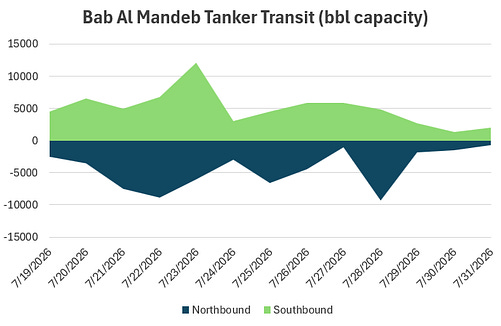 |
India, Russia, and China continue to transit the area with relatively few disruptions. Even so, both India and China, and despite China’s increasingly direct engagement with the Houthis, are becoming less confident about the predictability of those voyages. The main obstacle is insurance. Securing coverage for both vessels and cargoes has become extremely difficult, and Lloyd’s has made it explicitly clear that it will not insure anything transiting this Strait.
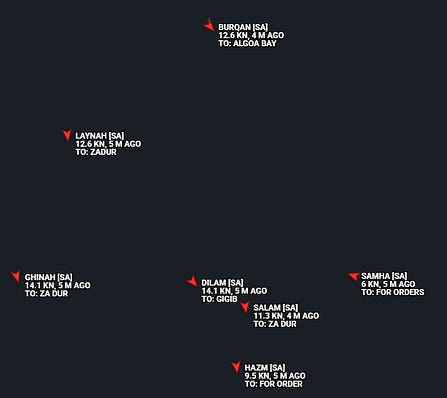 |
Bahri’s fleet has regrouped in the Gulf of Aden, with virtually all of its vessels signaling they intend to enter the Red Sea by taking the long route around. While clearly inefficient, there are simply not enough VLCCs available in the area. Most likely these vessels will be used as shuttle tankers feeding the SUMED pipeline, something Bahri/Aramco has always done, but now just on a much larger scale. Any volumes exceeding the pipeline’s 2.5 Mnbpd capacity will have to move on Suezmaxes.
It is therefore unlikely we will continue seeing VLCCs partially discharging and then reloading after crossing the canal. Instead, this is likely to become a Suezmax market, FOB Yanbu on one side, and FOB Sidi Kerir (Egypt), on the other, with pricing largely determined by Meds fundamentals. Fortunately, the loss of the direct route is not cost prohibitive. The additional transportation cost is only around $2.50 per barrel, plus whatever backwardation you get, something Aramco will almost certainly offset through new FOB Sidi Kerir OSPs, so you theoretically you could land these barrels competitively against Murban//Oman.
This problem will eventually solve itself, but it will take several weeks before a steady eastbound flow from Yanbu is fully established.
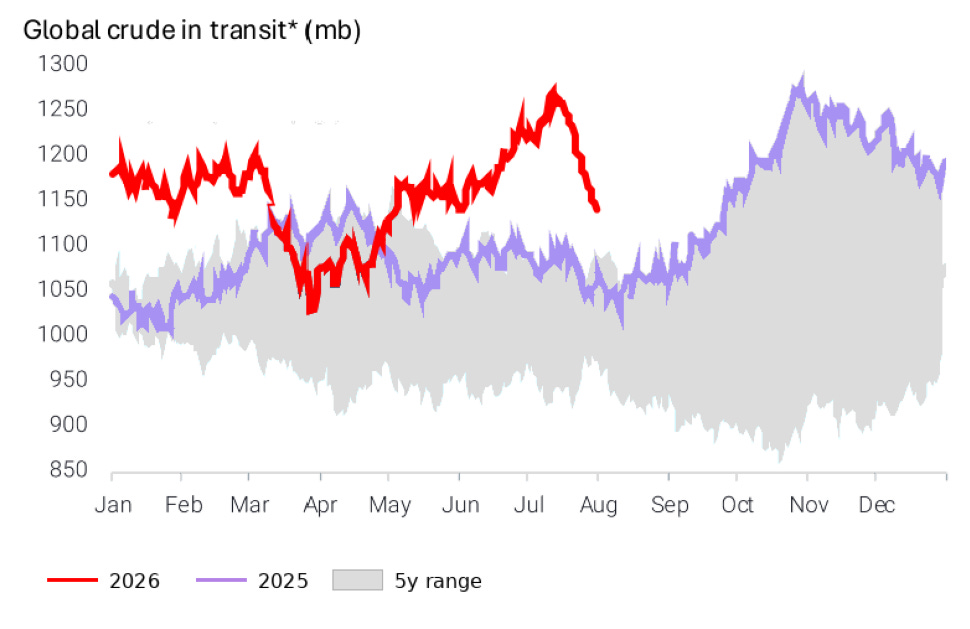 |
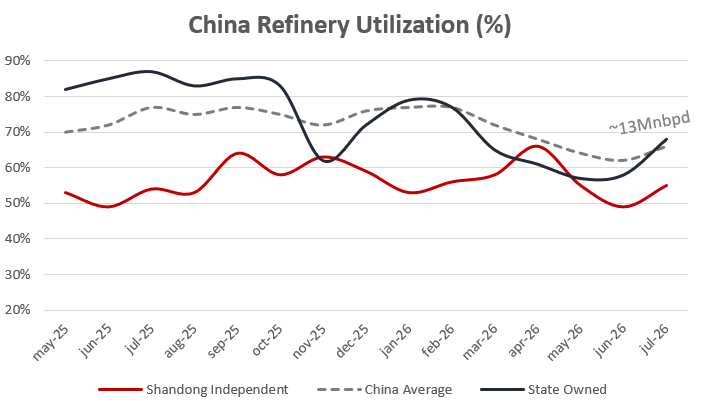
In the meantime, it is time to get creative because there are no more rabbits left in the hat. The floating inventory cushion that had been supporting the market has disappeared in a matter of weeks, and once again we find ourselves living hand to mouth. To make matters even more interesting, China appears to be undergoing a noticeable shift, both in strategy and in attitude.
 |
China has not only stepped in to negotiate with the Houthis, it has also attempted to broker discussions between Iran and several GCC countries while at the same time it is becoming much more active commercially, openly advertising the cargoes it has. PetroChina reportedly paid more than $15/bbl yesterday for a VLCC carrying Iraqi crude to China, and is actively looking for additional cargoes loading inside the Gulf, they are pretty much in “whatever it takes” mode.. WS465? yeah send it.
For now, China it is not relying on its own fleet, but rather on the handful of operators that routinely navigate these waters, two Greeks, a Korean, and a Turkish.
Just a few days ago I thought we would first need several consecutive days without attacks before tanker traffic gradually returned. It is becoming clear that the market is not willing to wait. The recovery has already begun. The consensus now seems to be that this situation will not be resolved before November... and not after.
Where I had been more optimistic was the Black Sea, where I believed the key actors, (Mr. Z), were somewhat more maleable. As expected, CPC resumed operations on Monday. As I did not expect, operations were suspended again on Tuesday Apparently, by late Friday they were resuming once more, but who knows what’s going on there…the situation remains extremely fluid.
Today only a handful of shipowners are willing to load at CPC Terminal, and all these repeated interruptions are having a much greater impact on the physical market than on the flat price. In fact, Brent M1/M2 has become almost completely detached from what is happening in the Dated market.
Despite all this turmoil, the market still has an effective shock absorber for prices when they cross above $90, there is nowhere to process these crude barrels, even if we could get them.
The world is currently short ~4 Mnbpd of refining capacity, and that is with the US running at 97%, Brazil at 103%, India at 90%, and Europe at 88%. China remains the only system capable of adding meaningful refining capacity in the near term, but for that to happen refiners actually need to make money processing crude, and with Brent at $90 that is not going to happen… so we are in this crossroads.
At the same time, refinery run rates outside Asia are becoming increasingly unsustainable. Within the next two months, virtually every refinery that should already have entered turnaround will finally have to shut down after postponing maintenance for as long as they could. That alone could remove another 2 to 3Mnbpd of refining capacity unless China and the Middle East step in to fill the gap. Some participants are beginning to float the idea of demand destruction through higher prices is the real solution….yeah but are you sure want that? Treasuries might have a say in this...
Subscribe to Oil not dead to unlock the rest.
Become a paying subscriber of Oil not dead to get access to this post and other subscriber-only content.
A subscription gets you:
| Oil Weekly Commentary | |
| A custom App and chat | |
| We might start doing webinars |
| ||||||||||


