
|



Greetings from northern France, where we have escaped for a short break. Below a few thoughts on a conundrum faced by Britain’s new PM, an essay on India’s cockroach movement, and the usual stuff to read.
Enjoy the weekend, and the summer break if you are away.
James
ps - I got an actual physical galley copy of my new book, The Perimeter, this week, which was nice. I will, as you might expect, be sharing details on all this soon enough.
 |
A dispiritingly occasional private mail for friends and family, with reading and other things that catch my eye. Feel free to unsubscribe below. If someone forwarded it, do hit the big blue button.

Burnham and foreign policy prioritisation
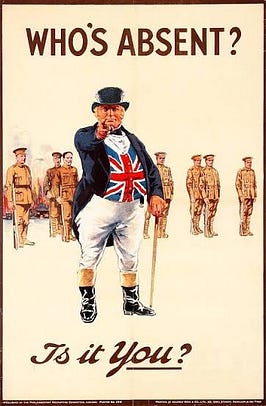 |
There has been a fair bit written about what if anything Andy Burnham might mean for UK foreign policy. I have to paper to write on this soon, so am pondering. One thought I wanted to explore is a conundrum faced not just by the UK but my most declining western powers.
Self-inflicted decline. Burnham wrote recently about the need to “re-build hard power”. This is obviously correct, albeit also an admission that decades of underinvestment have now left a hollowed-out military. Moving away from European partners didn’t help. Shrinking budgets and ceaseless reorganisations mean Ed Miliband now inherits a shrunken and traumatised Foreign Office.
Structural decline. Britain’s influence is not simply declining in absolute terms. Defence spending levels can and will rise. The bigger challenge is our club is shrinking. Loss of influence is inseparable from the relative decline of our major geopolitical grouping. Ben Judah put this well in a recent long FT piece:
Part of Britain’s waning influence is beyond its control. Some of the international institutions in which it has wielded power and global issues on which it has shown leadership are receding in importance. “The UN is in decline, the Commonwealth is in decline. The UK’s genuine leadership role and commitment on climate is less valuable than before,” says Ben Judah, a foreign policy specialist and former Labour adviser. “We are also losing influence because the west is losing influence. The western alliance is fragmenting, as the Chinese authoritarian axis is deepening…..”
This is a common western predicament. Britain’s position might be worse in some ways, but it basically true for Canada, France, Japan, and so on. All these powers face a world in which their flagship American partner is less reliable, if not hostile, and where the western club is now one bloc amongst many. Mark Carney’s idea of a rupture was really about both of these changes, not just Trump.
The false attraction of many emerging powers. Declining western powers now seek to save as much of the existing order as they can, while building new structures to replace it. It is natural in this situation to think about diversification to a wider range of emerging powers. The challenge is most developing economies do not have the capacity to do this. And as this essay this week on “middle power populism” puts it, many probably don’t want to. Even superpowers in the making like India are often extractive with international partners; New Delhi has little interest in helping buttress the old western-led system.
The danger of business as usual. Before she left office, ex UK Foreign Secretary Yvette Cooper published a long essay for Chatham House. It is filled with conventional thinking about the need for greater multilateral cooperation on issues like climate change and AI, as well as doing more with Europe. This is fine as far as it goes. But it does little grapple with Britain’s declining position and inability to make choices about where to spend its limited geopolitical capital.
A paradox of western middle power foreign policy. Britain’s hope of shaping international outcomes lie in husbanding scarce resources and concentrating them where they can do the most good. Even as the western group declines, that strategy still mostly depends on deepening cooperation with a shrinking pool of Western and Western-aligned powers. Japan is going to be a more important partner for the UK than Malaysia; Australia than Indonesia. In Asia, that means concentrating effort on the countries of the “global west” alongside select others, like India and Singapore, whose weight or influence make them disproportionately valuable.
A new focus on high-capacity partners. For medium sized countries, shaping a deteriorating international environment means acting with others. A foreign policy built around specialisation and doing fewer effective things is more likely to succeed. This means making a smaller number of bigger bets with high-capacity partners. As well as existing partners like Japan, this means focusing more efforts on high-capacity emerging powers with overlapping interests. There were many critics of David Lammy’s idea of “progressive realism” but one of its core tenets was that the UK should work closely with regional actors like Saudi Arabia or Qatar, even if their regimes made many in the Labour party squeamish.
Doing more with less? In practice, this points to a need to focus scarce resources, both in defence and diplomacy. There have been some good examples of this. Under Rishi Sunak, the Bletchley Park AI Safety Summit (briefly) set the global agenda on AI governance by convening a small group of nations, including China. (The Foreign Office objected to keeping the invite list small for fear of causing offence). In Asia, joining AUKUS and acceding to CPTPP were both deliberate choices to embed Britain more deeply within a smaller circle of trusted partners rather than spreading effort thinly. Ed Miliband traveled to Asia last week for ASEAN meetings, the legacy of earlier decisions to focus resources on Southeast Asia. The big risk for countries like the UK lies in pretending that they remain all-weather powers able to do a little bit of everything.
Plenty of other good things to read on this, in particular. Lucy Fisher in the FT on Britain’s “power problem”, Ben Judah on Burnham’s foreign policy challenges, and Jon Bew on the “The global crises Andy Burnham cannot escape"“ in the New Statesman.
Worth reading
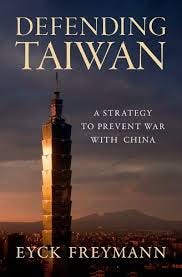 |
The Loneliest Island. Will America Truly Defend Taiwan? I’m making a BBC documentary at the moment on Taiwan (more soon), in which we interviewed Bonny Lyn at CSIS. In this piece for Foreign Affairs, she discusses an excellent new book by Eyck Freeman on Taiwan, while also asking a question that is at the heart of The Perimeter. (TLDR: under Trump, nobody really knows.)
If the United States pushes back on China’s gray-zone tactics, China will inevitably retaliate. Imposing costs on Beijing could easily lead to an escalation spiral. For this approach to be effective, the United States needs to show that it will not relent even if China matches American pressure at every step. At present, it is not clear whether the United States is willing to do so….. Instead, the second Trump administration believes that U.S. allies and partners should take more responsibility for countering China’s gray-zone coercion of Taiwan. And a small number of U.S. experts and policymakers—including some within the Trump administration—are arguing that the United States should walk away.
The age of the genius general is over. In thinking about my own piece for Engelsberg Ideas, I also found this by Ed Stringer, on why training military commanders to develop tactics of “intuitive brilliance” no longer works.
‘Getting on’ in the higher echelons of the British military still hinges on giving your superiors the impression that you have ‘it’. ‘It’ is undefined, and, indeed, unmeasurable. But it clearly suggests you are one of Napoleon’s ‘lucky generals’, a charismatic practitioner of the operational arts. You have the mark of genius, an intuitive capacity to win that transcends rational explanation….. But as we move into the Information Age our generals will have quants of their own. AI will chew over many orders of magnitude more data … algorithms will have self-trained by endlessly churning mass data…. They will generate both counterintuitive analysis and options for action. How, then, is a system predicated on the intuition and instinct of a single genius general going to cope?
What training my chaotic dog taught me about power, control – and human beings. Charming and erudite piece by Will Davies in the Guardian, on the philosophical challenges of his unruly boxer, Dusty.
We are all familiar with the cliches of Britain as a “nation of animal lovers”, but we often overlook quite how weird and remarkable it is that we have, for the most part successfully, integrated a vast number of autonomous, non-human entities into a human system of rights and wrongs. As I tried to integrate Dusty into that system, however, I discovered how difficult and fraught the process is. I also began to see how much of what I write and think about in my professional life as a sociologist – power, behaviour and control – reflected what goes on in the world of dog training.
Things that caught my eye
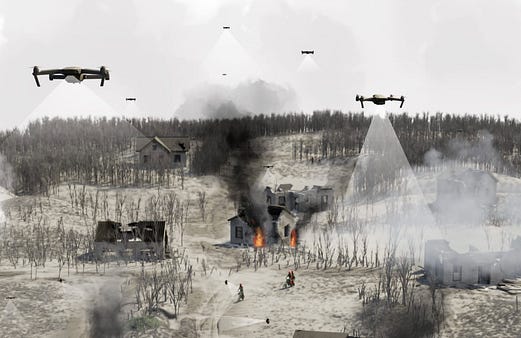 |
Inside Ukraine’s Kill Zone. Impressive and unusual interactive graphic from Reuters which takes you inside the Russian and Ukrainian battlefield front-lines. Take a look.
How good is Kimi3? UK AISI tested its cyber chops. TLDR: good, but not as good as the best of the American models.
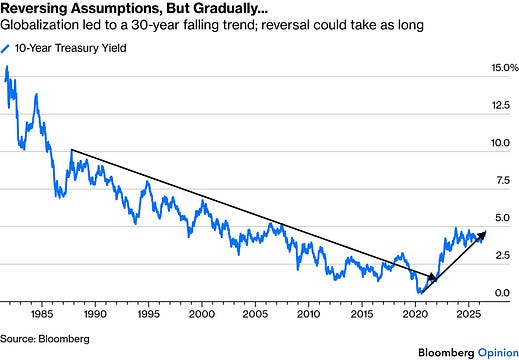
The end of low rates. Via John Authers: “The result is a steady increase in the cost of doing business, reflected in higher inflation, higher costs of capital, and steadily rising bond yields. Just as globalization was a key factor in the multi-decade declining trend in bond yields that followed Paul Volcker’s war on inflation, so raising the drawbridges has now triggered a steady rising trend.”
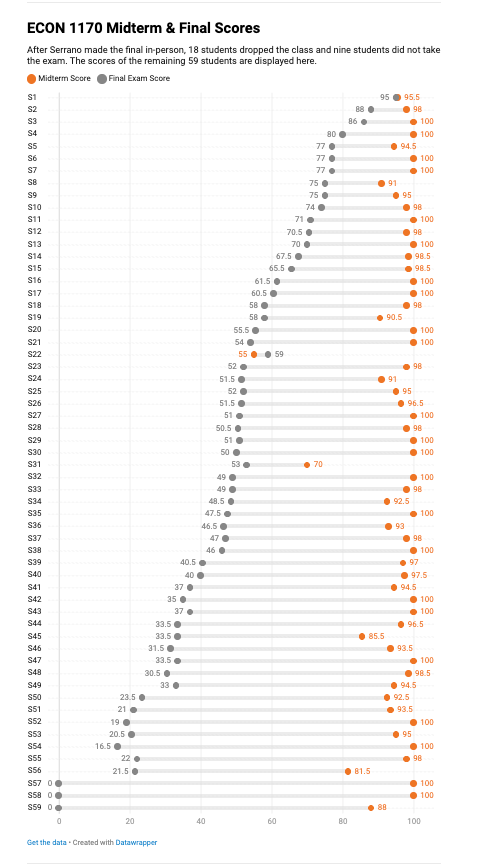
Ubiquitous AI exam cheating. This chart was everywhere on LinkedIn, as Brown econ prof Roberto Serrano uncovered near universal cheating on a take-home exam. Spare a thought for Student 22 below.
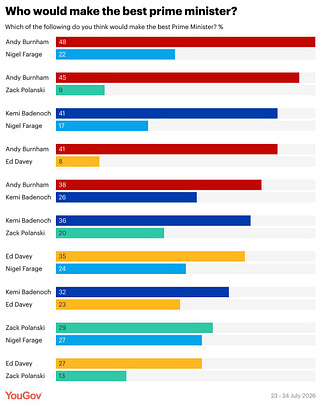
Burnham Bounce. Labour has gone from Britain’s least popular political leader by miles to its most popular, for now at least.
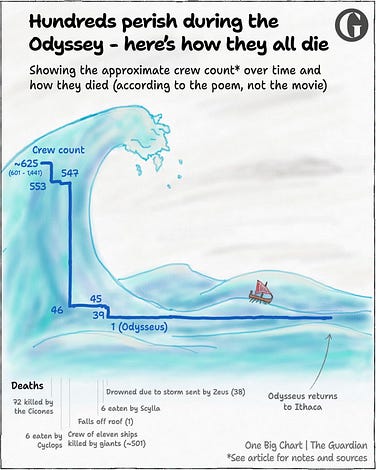
Spoiler alert. I saw The Odyssey this week, which was long, loud and …. ok? Adam Tooze was interesting as ever on the film’s economic context. This chart from the Guardian explains the story in rather less time than it takes to watch it.
 |
What I’ve been up to
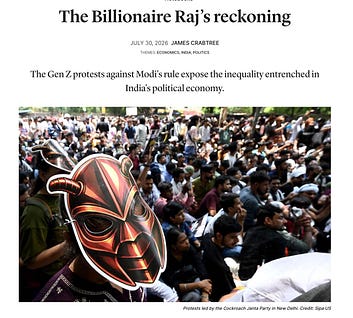 |
An essay on cockroaches. Thanks to the good people Engelsberg Ideas for suggesting this on India’s protests, and what it might mean for Modi.
“India is still led by its most powerful government in living memory, and arguably its most politically dominant leader since Prime Minister Jawaharlal Nehru, who governed the country following independence in 1947. Eventually the laws of political gravity must take hold. So far, though, Modi appears impervious, not least given he faces a rabble of divided opposition parties. Only a brave pundit would bet against him winning a fourth term in 2029, equalling Nehru’s record.
For all that, Modi’s government is clearly struggling to make headway on the domestic and international challenges that will determine the country’s trajectory over the next decade. India’s problems of worklessness show no signs of improving, just as its foreign policy position grows more complex. Even while the Cockroach protests are unlikely to shake his grip on power, they do illustrate Modi’s powerlessness in getting to grips with the challenges India faces.”
Next up: In London during August, then briefly in Zurich in early September, and then Washington at the end of that month.
ps — I do talks, moderating, and so on. Drop me a line.
 |
Thanks for reading. If this was forwarded to you, and you’d like to get it in future, feel free to click the blue button. You can also add me on LinkedIn.
| |||||||


