
|


This week the colorful note was a major bank admitting defeat and giving up on “modelling” the oil markets, I won’t mock them because I gave up years ago but it got me thinking if they found the same pitfalls I encountered when trying to guess where this market might go next from an input/output standpoint. I won’t ridicule those who still model it because, even as seen as a purely academic exercise, it is an exercise nonetheless and helps to combat cognitive biases, which in this space are copious. So, keep modelling… but take these counterarguments to bring your models closer to how oil moves hand to hand.
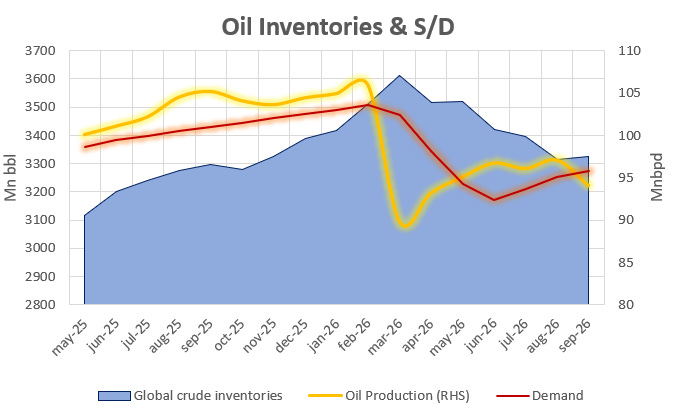
Most oil modelling starts at the two end points of the system, production and demand, which at the very least, is flawed data, and then adds the inventories as the balancing mechanism, but is it really such a thing?
 |
Let’s start with supply, we might have an educated guess of how much oil is produced, but a proper model should not have the headline figure but also what, when, and where is produced.
The what is easy to answer, there are comprehensive public databases (GEM) and with a little excel dexterity you can get as close as anyone could get. This also answers the “where”, but none of these answer the “when”, and that’s critical because not all molecules have the same marketing cycle.
*Not upstream expert but oil is siphoned up from the ground, them put in a processing tank to separate the water, then set aside for sediments to precipitate, then injected in a small pipe that goes to a bigger pipe that goes to a refinery.. maybe 5 miles away, maybe 300.. or maybe it goes 1000 miles to a tank at a marine terminal. The thing is we don’t know where the molecules produced yesterday are in the system… you might say -but this is a continues flow, who cares?.. and you are right but think of this, that flow is continuous but not constant, ie you might have contracted certain pipeline capacity out of a well, but that gives you a right, not an obligation (sort of a call option) to fill the pipes, so you can detour some flow to other pipeline system, you could hold your barrels in processing for a little longer, you could put it on a truck.. I don’t know.. the key is optionality (a word we’d hear often today).
Demand, this one is easy because crude oil demand = refinery intake, there are like 950 refineries in the world, ~95Mnpbd in nameplate capacity…add something for Saudi direct burn and you have max possible demand. Now, refineries choosing to go at a certain run rate go hand in hand with producer optionality, and on top of that their own optionality as well.
So, refinery demand is derived from end user demand, cool, now you have to model 7bn people with different income levels, exposed to different pricing schemes, embedded in different institutional and cultural structures, oil intensity economies…and now add consumer psychology.
I was an early advocate of “demand destruction”, like so many in this sphere and I’m scratching my head wondering why with gasoil at $200/bbl we don’t see demand falling of a cliff? Because it is still perceived as “cheap enough”. Look at oil as a utility rather than as a good, how much the other services have gone up in the last years? Car payments? Housing? You complain, but you end up paying. I’m spending maybe $70 more in fuel each month, and I curse Trump and the whole industry every time I refuel, but I can afford 70 bucks extra and so can 75% of the global oil end user, the baseline oil demand where we can now include China and parts of India, but what about those who can’t afford $70 extra? That’s the hard part to model since we are lacking retail data, mobility data, etc, and those are often the countries shielding consumers through price caps, tax exemptions, encouraging end users to consume even more, because psychology dictates tomorrow might be more expensive.
So, we can only infer and the problem with commodities markets is that prices are formed on the margin, so if you miss 300kbd of clustered demand, that’s one MR tanker a day, enough to throw the Asian gasoline market in disarray.
And then we have oil stocks. As the general theory of storage says, there is a direct correlation of spot and future prices given certain inventory levels and storage cost. Some of that still plays a role, as we saw with the SPR release, but the commercial stocks have other incentives and practices. The tricky part of modelling is to identify when they add to supply or when they subtract from demand but in practice is neither.
Oil inventories (if you have them) are an ATM: You don’t draw inventories, you borrow against them and go and bid on the spot market, that’s how China can afford to pay these stupid prices. And again, that gives you optionality to release, to build, to lend.
Financial incentives derived from the futures curve structure can further amplify these trends that might not align with the other participants down and up the chain.
And finally, to all this you have to add oil trading complexity, the financialization of the product itself, and not talking about funds buying futures, I’m talking about having a crude cargo floating at sea, selling gasoil paper on that cargo and borrowing against that unrealized PnL to go and bid in the Dubai windows to push prices up at the same time you are selling Brent-Dubai spreads because you don’t yet know if you are selling that cargo to a Taiwanese or to an Italian refiner… flows change intermittently.
So, I say it is impossible to model the oil market, because there isn’t AN oil market, but different subsets of smaller markets that expand or shrink due to different visions across the supply chain. You can only react to these changes, and sometimes you can model behavior that is what we try to do here...
Subscribe to Oil not dead to unlock the rest.
Become a paying subscriber of Oil not dead to get access to this post and other subscriber-only content.
A subscription gets you:
| Oil Weekly Commentary | |
| A custom App and chat | |
| We might start doing webinars |
| ||||||||||


