
|
The Perimeter: my new book on America, China and the world’s most dangerous geopolitical fault line
Let me know what you think of the cover, although only if you like it.
|
| ||||||||||||


I’m on my way to Washington and New York today, but i thought I’d finally send out a few details on the new book, including the cover, along with the first of many gentle entreaties to pre-order. It is out in January.
Elsewhere I have a new essay up at Foreign Policy on the bigger context behind this week’s Trump / Xi meeting in DC on Wed and Thur, and my new BBC documentary Taiwan: The Pacific Breaking Point airs today.
I’ll do a more regular post with the usual recommendations and tidbits next week. Enjoy the weekend.
James
 |
A dispiritingly occasional mail for friends and family, with reading and things that catch my eye. Feel free to unsubscribe below. If someone forwarded it, feel free to subscribe.
“An insider’s journey along the world’s most important geopolitical fault line….”
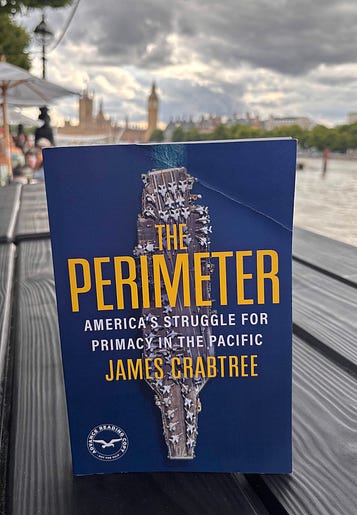 |
For the last few years, as most of you know, I’ve been writing my second book. It is an odd feeling now to be thinking of putting it out into the world, after so much work. Anyway, all of this is to say that The Perimeter: America’s Struggle for Primacy in the Pacific is done, and available for pre-order 🤓 📖 🥳. Did I mention it is out in January?
A few weeks ago, my excellent publishers at Norton in New York sent me a copy of the American edition. It is still the only one I have. I took a picture of it out and about in London, which you can see above. Book covers generally cause a great deal of agonising, but I’m pretty happy with what we came up with.
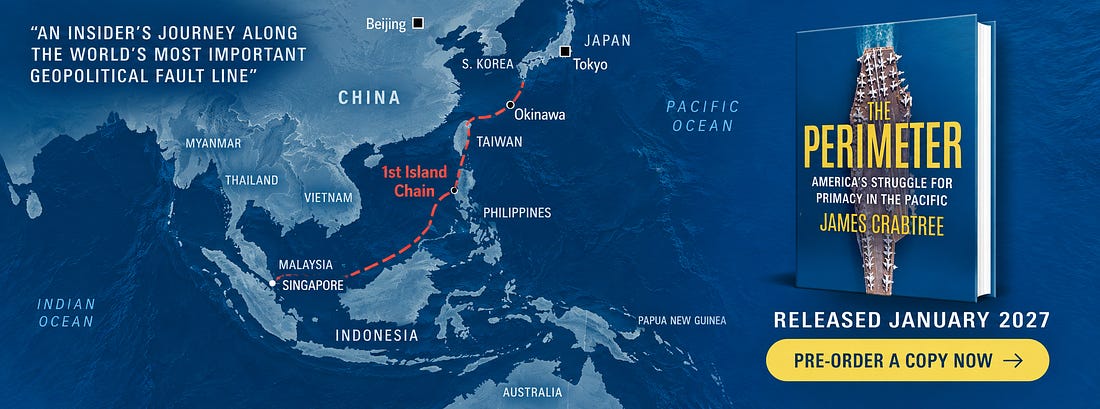
I’ll be writing a lot more about the book here and elsewhere: why I’m excited for people to read it, what it is about, and why I wanted to write a big story about the “first island chain”, the eponymous perimeter in the title.
At base, I wrote the book because I think it tells one of the most important stories of our time. I spent the last few years travelling along the island chain to try and explain first hand why it is the world’s most important geopolitical fault line — albeit one surprisingly few people have even heard of.
In passing, the book has lots of excellent maps, including those showing the chain itself, see below 👇
 |
Why should you care? The perimeter line is the most likely source of a future conflict between the United States and China. It also represents the biggest challenge the US faces if it is to maintain its position as the world’s preeminent power — and one that is now far more pressing given Trump’s return as President.
Writing the book took me on a fascinating historical journey too, running from the presidencies of Truman to Trump, learning how America's place in the modern world was first built, and how it now finds itself under unprecedented pressure. Above all it is what I hope is a gripping human story, about the people I have met — soldiers, strategists, policymakers, intellectuals — fighting to preserve America’s position in the Pacific, and thus the world.
Here is what the dust jacket says:
The United States has projected power across the Pacific for more than a century. Yet few Americans know their country has a forward defensive perimeter in Asia, where more than sixty U.S. bases support nearly 400,000 troops patrolling a vast oceanic frontier. Award-winning author James Crabtree explores this vital maritime theater and argues that the United States must urgently reinforce it, or lose its supremacy in the Pacific, and therefore the world.
Combining riveting storytelling with unprecedented access and cutting-edge analysis, The Perimeter examines the critical importance of the “first island chain,” the fate of Taiwan, and the future of America’s contest with China. Crabtree blends history, strategy, and first-person reportage to lay bare the traditional mechanisms of U.S. power in the Pacific, and how they have struggled to adapt in the face of “carrier killer” Chinese missiles and other futuristic defense technologies.
In this compelling journey along America’s least famous border, from Hawaii and Guam to Japan, the Philippines, and Taiwan, he visits the Taiwanese beaches that would become landing zones in a Chinese invasion, gains access to American military bases where U.S. Marines are retraining for radically new forms of warfare, and meets Asian leaders struggling to navigate between clashing superpowers.
All of which is a roundabout way of saying that this now begins a process of months of slightly awkward / shameless self-promotion. I hope some of this might even be interesting, given I’m going to try to explain the journey I went on in writing the book, and what I learned along the way.
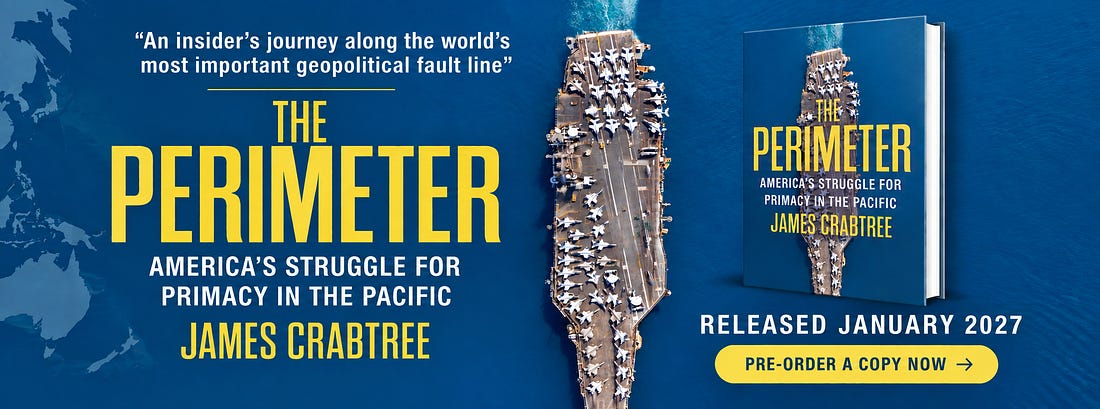
And now the plea: if you might think about buying it, please do consider pre-ordering rather than waiting until January. Pre-orders matter a lot, hence why publishers tell authors to bang on about them relentlessly, given they shape how the book is treated by retailers and count towards a successful launch.
🇺🇸 In the US, all the retailers are listed on the Norton website, but you can get it at Amazon, Apple Books, Barnes & Noble, Books-A-Million, Bookshop, Hudson and others.
🇬🇧 In the UK, you'll find it at Atlantic Books, which is the UK publisher, which has also links to Amazon, Waterstones, WHSmith, Foyles etc etc. It is available on all the usual places in Australia, Japan, India, Singapore and everywhere else too.
Beyond that, there are a bunch of ways friends can be helpful, from sharing posts, and telling other people to writing reviews, offering sage advice on promotion, hosting book events, and so on and so forth. And, of course, if you do pre-order, thank you…..
 |
What I’ve been up to
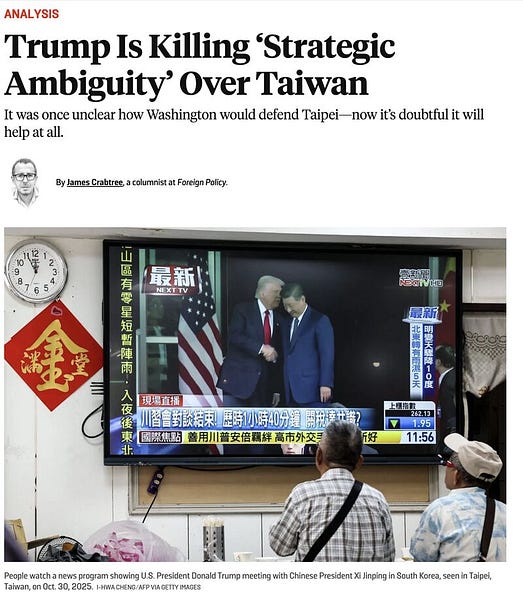 |
A new essay as and Xi meet. Xi Jinping will meet with Donald Trump at the White House on Sept. 24 for their second summit this year. In Foreign Policy i sketck out a few thoughts on the deeper significance of what is going on at the moment. Read it here as a gift link or a PDF.
The gist:
Even if U.S. policy toward Taiwan remains formally unchanged, a deeper worry should lurk beneath these immediate anxieties. Washington’s long-standing policy of “strategic ambiguity” over its intervention in any conflict over Taiwan appears to be gradually drifting toward a new posture of weaker support. The slow death of strategic ambiguity, in turn, risks miscalculation by China, bringing fresh instability into an already complex and dangerous regional balance…..
Partly this is because Trump himself clearly cares so little for Taiwan. He treats the island with a suspicion normally reserved only for freeloading full U.S. allies. He suggests that the Taiwanese government “stole” America’s semiconductor industry, too. At the same time, Trump shows little patience for the kind of geostrategic arguments about defending the first island chain that have long animated Washington’s China hands. As he said after his meeting in May, “We’re supposed to travel 9,500 miles to fight a war? I’m not looking for that.”….
Formally, there has been no change to U.S. Taiwan policy. Senior officials insist strategic ambiguity remains intact. U.S. Undersecretary of Defense for Policy Elbridge Colby recently gave a speech in Manila arguing that the Pentagon is still rebuilding deterrence against China along the first island chain, which includes Taiwan. The United States was “digging in” in Asia, he said, not disengaging…..Rather than a decisive shift toward strategic clarity, in which it becomes explicit that the U.S. would indeed support Taiwan, the more realistic prospect is a policy that drifts quietly in the opposite direction, toward not supporting Taipei at all. The danger is that a combination of Trump’s off-the-cuff rhetoric and the restraint-minded ideas circulating in Washington changes China’s calculations. If Beijing comes to believe that the risks of moving against Taiwan have fallen, it may be tempted, sooner than expected, to test that resolve directly. Strategic ambiguity had a deterrence effect that will now likely be lost.
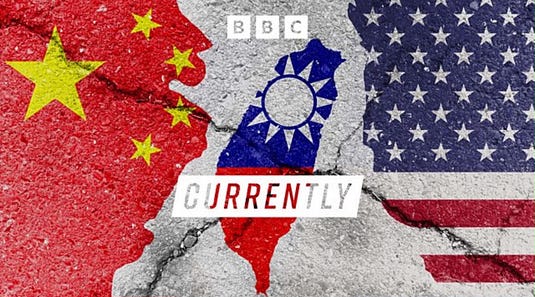 |
My BBC documentary, Taiwan: The Pacific Breaking Point, goes out today on radio and podcast.
One of the most fun things about making it was corralling an all-star cast of guests, including David Feith, Bonny Lin, Bonnie Glaser, Henry Wang and Jason Hsu, who between them know as much about the US-China contest over Taiwan as anyone. Anyway, it was great fun to make, and I'll write a bit more about it here soon when it is out.
If you are in the UK and like the old-fashioned wireless, it goes out over the coming days.
More likely you can get it by subscribing to Currently, the BBC’s main documentary series, on iTunes or Spotify.
Next up: Washington / New York. I’m speaking at the London Defence Conference DC Forum this coming Wed. Drop me a line if you want to come.
ps — I still do excellent talks, moderating, and so on. Drop me a line.
pps — pre-order :-)
|
Thanks for reading. You can also add me on LinkedIn.

| |||||||


