
|
A mafia boss theory of Trump / Xi meetings
Explaining a diplomatic nothing burger, my new BBC Taiwan documentary, and the meaning of LinkedIn.
|

| ||||||||||||


Greetings from a wet Long Island, where I am at a US / China meeting, at a fancy gilded age mansion, following a fun week in DC and NYC. I fly back home tonight.
Below a muse on the puzzle of this week’s big but pointless Trump / Xi meeting, as well as the usual reading recommendations and other ephemera.
Enjoy the weekend!
James
 |
A dispiritingly occasional mail for friends and family, with reading and things that catch my eye. Feel free to unsubscribe below. But if someone forwarded it, feel free to subscribe too.

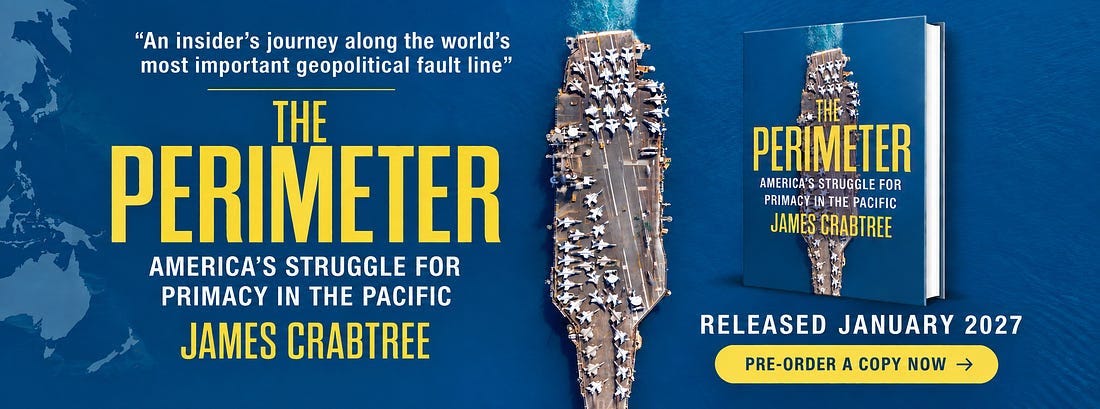 |
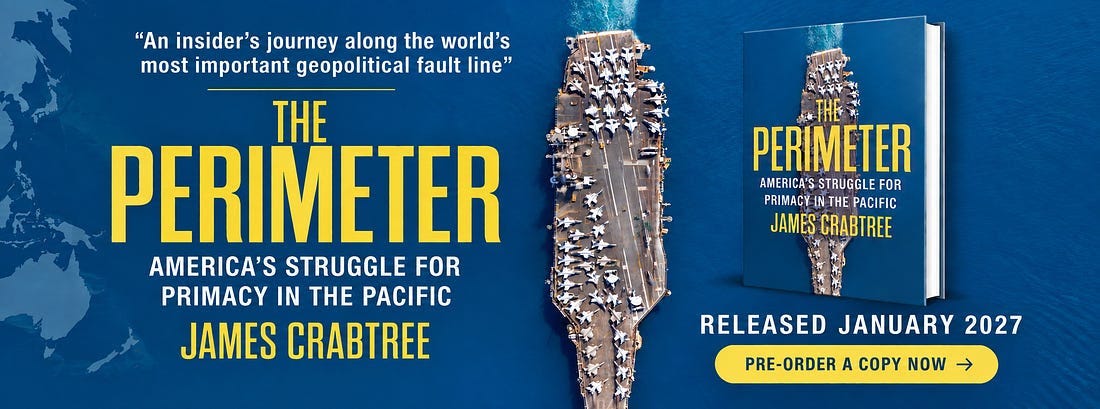
I have new book coming out in Jan. I wrote about it here. Huge thanks to anyone kind enough to pre-order, which makes a difference for nervous publishers and struggling authors alike.
The sit-down: a theory of Trump and Xi in DC
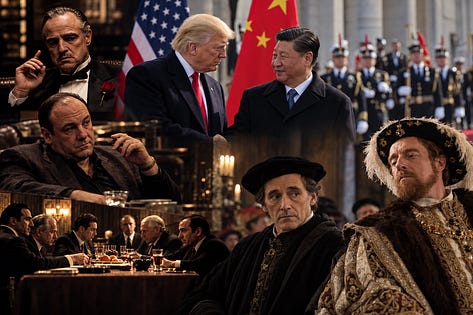 |
The US / China meeting was a strange affair. The world’s two most powerful countries came together with fanfare and tried to achieve… nothing very much? I’ve been puzzling for a while why Trump gives autocrats such lavish respect and yet so often treats allies with contempt. Below some thoughts on this, by way of Goodfellas and Wolf Hall.
A diplomatic nothing burger. The post-meeting consensus was plenty of pageantry but no substance, which seems right to me. The two leaders extended a trade truce — albeit only for a mildly embarrassing two months — and nodded towards working together on AI. But mostly it was pretty much nothing to see.
It is good to talk? At a basic level you might say this is a good thing. It is positive that the world’s two most important powers are talking, not fighting. It is also reasonable to think that regular leader-level contact somewhat lowers the risk of a future miscalculation or crisis — think balloon 🎈— getting out of hand.
Nothing this week was difficult for Xi. All that said, the odd thing isn’t that Trump was a bad negotiator per se; it was more that he didn’t really seem to want to negotiate hard at all.
Nick Burns, former US ambo in China, put this well, while David Rennie at the Economist also made the point that this kind of pointless pageantry is… not great? This was how Amb Burns put it:
“ I think the president, our president, is pulling too many punches. He hasn’t raised Taiwan effectively. He hasn’t raised an issue you mentioned, Amna, Chinese support for Iran and for Russia in the Ukraine war. So I think the policy is too weak right now. We need to be truth-tellers with the Chinese, and I think they will respect us more if we’re stronger at the negotiating table.”

Don Trump. So why did so little happen, and why is Trump so nice to Xi? One way to think about this is through the analogy of a mafia family. It is often said that Trump runs foreign policy as a kind of relentless shakedown racket, and there is some truth to this. But it seems to me there is a deeper psychology at play here, and one that goes some way to explaining who gets whacked and who gets courted.
Mafia law says treat rival bosses with respect. Bosses command soldiers; they can hurt you. Relations are thus governed by ceremony, courtesy and careful sit-downs. Your underlings, by contrast, are foot soldiers, to be treated as expendable. They owe tribute and loyalty. In thinking about this I was reminded of this quote from that splendid NYer profile of Peter Navarro as “Trump’s Ultimate Yes-Man”
Long-term service to Trump requires both egomania and its opposite: self-annihilation.... the Boss seems to value insincere, or bought, obeisance—the flapping and fussing of a maître d’—more than heartfelt fandom, which lacks the piquancy of humiliation.
Think of the meeting of the “five families”. In The Godfather, Corleone sits across from Barzini and Tattaglia, the men behind his son’s murder, and makes peace with elaborate dignity. Meanwhile, Carlo, a member of his own family, ends up garrotted in a car. The Sopranos makes basically the same point over six seasons. Tony handles the New York family (Carmine, Johnny Sack) with wary deference. His own crew (Christopher, Paulie, the capos) are berated and threatened.
It is the same in Goodfellas. The bust-out of Sonny’s restaurant shows what “protection” really means. Sonny’s problem is Tommy DeVito (Joe Pesci), who runs up tabs he never pays and bullies the staff. But once Sonny asks Paulie for help, he becomes a source of revenue, and every excuse is met with the same answer, which at base is not a bad description of how Trump talks to allies about tariffs and defence spending.
“Business bad? Fuck you, pay me. Oh, you had a fire? Fuck you, pay me. Place got hit by lightning, huh? Fuck you, pay me.”
Mafia politics and court politics. When trying to understand these kind of complexities, and the inner workings of political power, I also often return to Hilary Mantel’s Wolf Hall. It is perhaps my favourite novel, and especially brilliant on how power actually works up close, as a function of proximity, favour and fear. And the court politics of Henry VIII show a similar pattern to these mafia families, where being treated with honour depends on rank and threat, not loyalty.
This is how a Prince behaves. Henry is unfailingly respectful towards foreign royals, including his “brother France”. Tudor monarchs addressed each other as “brother” or “cousin”, a sign that they saw themselves as members of a tiny regal club of equals that stood above everyone else.
Henry treats regal counterparts with respect because they are a threat. Rival kings are peers with whom one might go to war. His own dukes and barons — the rough equivalent of modern allies — are treated with frustration. They are there to serve, and to stop rebellious Scots invading, and so on. Henry relies on Cromwell’s advice, but he also regards even his closest adviser as incapable of understanding how princes deal with one another. Conversations between kings belong to a different order entirely.
The Trump / Xi sit down. In Wolf Hall, the English court crosses the Channel in 1532 so Henry can meet the French King, Francis I, at Boulogne. The whole enterprise is an exercise in display, designed to show one king to another as an equal, much like Trump waiting at the airport in DC this week. Trump, I think, at some deeper psychological level, behaves in just this way. Xi is a fellow prince or a rival boss, while Japan or Europe are merely troublesome courtiers or low-level henchmen. In any case, we are likely to see a good deal more of this before the end of the year, given possible Trump meetings with Xi (twice!), Putin, and maybe even Kim Jong Un. And as in any good mafia movie, when the bosses talk peace, the foot soldiers begin to worry which of them might get whacked next.
Podcast of the week!
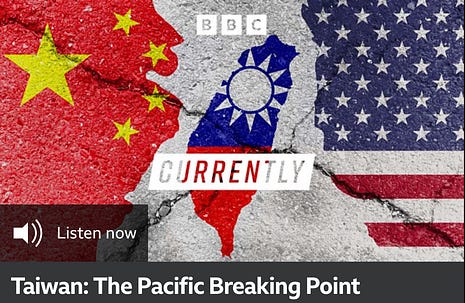 |
My first BBC documentary. This just came out, for BBC Radio 4, to coincide with Trump / Xi. It was fun to do. The basic argument: two big things have changed for Taiwan in the last two years. The first is Trump’s return: he plainly cares less about Taiwan than his predecessors. The second is the global AI boom, which makes Taiwan, and its chipmakers, ever more central to the global economy. Put those together and despite the high-level Trump / Xi amity, you have a more fragile and complex situation than at any point in recent memory.
An all-star cast. I was lucky to assemble a cast of star guests, from David Feith and Jason Hsu to both Bonnie Glaser and Bonny Lin. My friend Rana Mitter, ever ready with a quip, pointed out that if I’d only found one more Bonnie to interview, I could have solved the three-Bonnie problem.
Take a listen. You can hear the show on the BBC or via iTunes or Spotify on the BBC Currently podcast stream.
I also went on the BBC Radio’ 4’s Today this week to talk about it, which involved staying up very late in New York, hence the slightly bleary voice. You can listen to that here. Be warned: my daughter Sophie, who is 9, listened to it and said it was really boring, but i thought it was ok.
ps - even the Telegraph said the documentary was good!
 |
Reading Recommendations
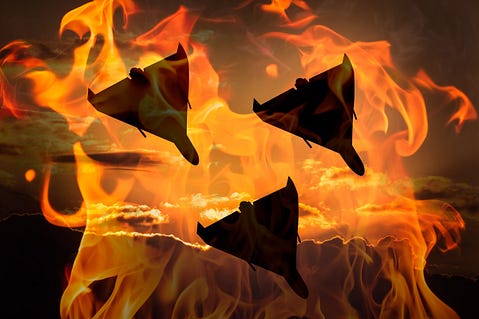 |
Welcome to Hellscape. Right on the core topic of The Perimeter, this excellent and optimistic piece from Aaron Connelly looks at how drones and AI might be about to make defending Taiwan a whole lot easier.
Dubbed “Hellscape”, the plan draws on lessons from Ukraine and Iran in using large numbers of low-tech drones, combined with artificial intelligence, to frustrate a far more powerful adversary. It envisions flooding the Taiwan Strait with relatively cheap aerial, sea-surface and underwater drones just as Chinese forces launch an attack. Assuming that China jams communication links with these weapons,they will strike Chinese ships using inertial guidance, image recognition or on-board AI that prioritises targets, evades countermeasures and co-ordinates attacks with other drones. That will not stop an invasion. But it could raise the costs and buy time and space for American warships and planes to reach Taiwan.
In Fighting for Every Black Child, Did I Betray My Own. Extraordinary, agonised essay by Nikole Hannah-Jones which lit up social media this week, asking if she, as a black parent, made a mistake sending her daughter to a public school. Ian Leslie had a thoughtful post on it too.
My child just shook her head, her face a mask of disbelief, and something else: betrayal. “So you had money to send me to one of the best schools, and you chose not to?” she said, hurling her words. “Because other kids are disadvantaged, you didn’t want to put me in a great school?” Najya was asking what I’d accomplished by not choosing the “best” school for her. And the honest answer is, I don’t know. When it comes to the choices my husband and I have made about public education, these days I feel that I failed both my values and my child.
What is LinkedIn? Another brilliant / funny post from my generally brilliant / funny friend William Davies, on slop, AI, self-promotion, and the horror of writing in single sentence paragraphs.
It is a cliche (though also true) that the obligatory mood on LinkedIn is endlessly upbeat, ‘thrilled’ and enthusiastic, as if everyone is constantly in the process of marketing themselves and avoiding the risk of alienation or offence. If one can stomach the gloop, the benefit of this is that conversation is less likely to get derailed, misconstrued or deliberately disrupted.
There’s a certain epistemic and normative stability in place, that makes for a more efficient and reliable experience than is available on other platforms, making LinkedIn a valuable social utility well beyond professional or employment-related exchanges. To put that another way, here is the open internet without the constant risk of trolling, shit-posting or context collapse, that was a constant undercurrent of the first three decades of the social web.
By anchoring a platform in the social institution that provides the very basis of capitalist modernity (the labour market) LinkedIn enables a means of digital co-existence that lacks friction or cynical mendacity. This is social media without the lurking imminent eruption of humour or conflict - precisely the things that people were seeking to escape when they abandoned Twitter/X.
Other things that caught my eye
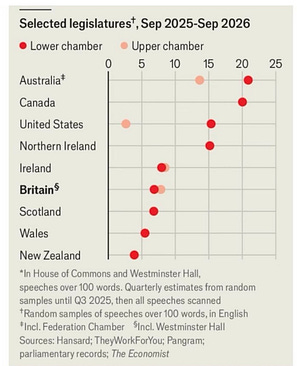 |
G'day.AI. Australian MPs are most likely to write speeches using AI. Their counterparts in New Zealand write longhand by candlelight, it seems, as do American senators, just as Jefferson intended.
Ukraine’s war game. Thanks to Louis Mosley from Palantir for telling me about Ukraine’s astonishing system of gamefied warfare Ukraine and the “Brave1 Market” where troops can use their kill points to buy new kit. You can read about it in this piece: Ukraine turned war into a point-based game with a real-world rewards market.
A standard infantryman could be worth six points. A tank used to fetch forty (they are worth less now since Russian tanks are not considered a high-value target at the moment). A mobile rocket system or a high-value electronic warfare suite can net a unit seventy points or more. Evacuating wounded friendlies? You are looking at possibly 120 points…. Every point must be verified through the DELTA system, a cloud-based battlefield management tool. No payout occurs without a timestamped, geo-located video feed of the impact. In the Brave1 Market, that is a down payment on a fresh stack of FPV drone interceptors….. Simplicity is the game here; if you can prove the kill, you get the gear.
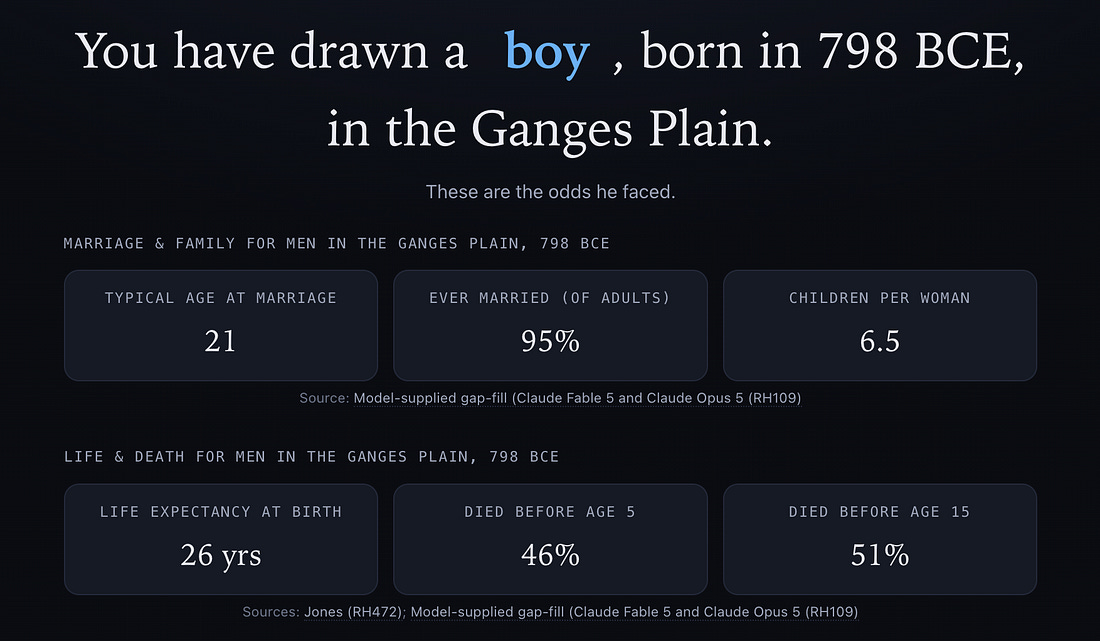
Any Human Ever. Genuinely fascinating site, found via Helen Lewis, which randomly generates people from throughout human history, to explain the mostly nasty, brutish and short lives they lived. Thank your self lucky for medicine and plumbing. Check it out:
What I’ve been up to
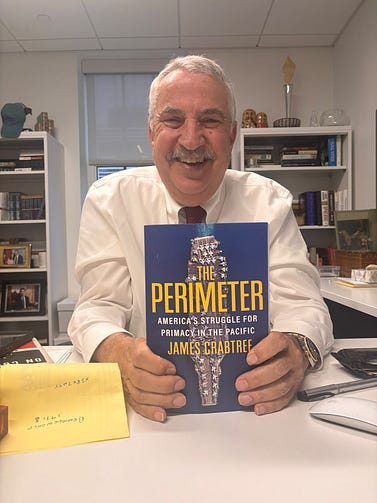 |
The Perimeter is flat? Nice to see Tom Friedman in his office in New York.
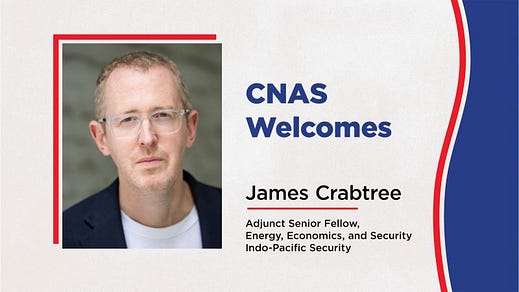
A new DC hat. I’ll be doing some work with the excellent people at CNAS.
London comes to Washington. I was at the London Defence Conference DC forum, which I wrote about here, including a rare sighting of Bridge Colby. More on what he said here.

Next up: Zurich (briefly), Cannes (also briefly), and then Beijing. I’ll be back for my annual spell at Schwarzman in Beijing w/c Oct 19, if any of you are around.
ps — I still do excellent talks, moderating, and so on. Drop me a line.
pps — did i mention pre-order :-)
 |
Thanks for reading. You can also add me on LinkedIn.
Thanks for reading James Crabtree! Subscribe for free to receive new posts and support my work.
| |||||||


