
|


So we are stuck in the 100s; neither the promises of kinetic action, nor the “back to pre-war levels” talk can break the cycle. Even the most volatile portion of the oil complex (refined products) seems contained with crack spreads revolving around headlines but settling at the starting point.
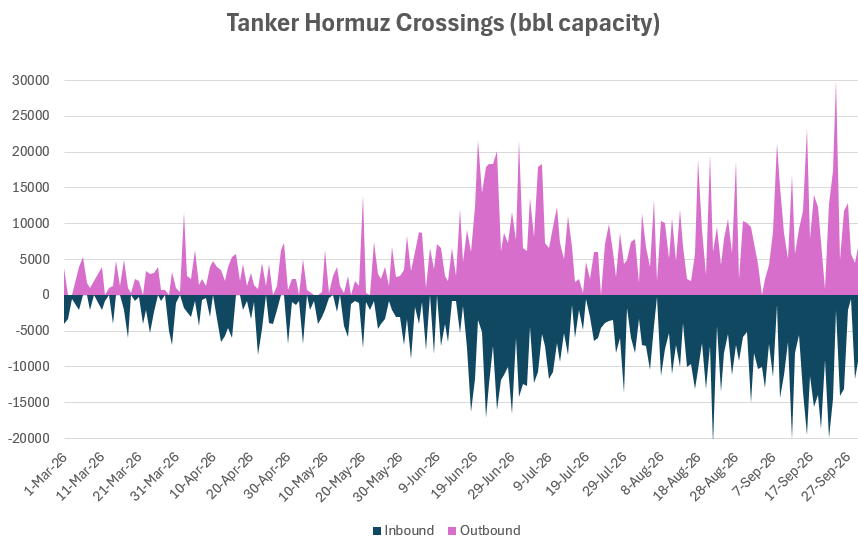 |
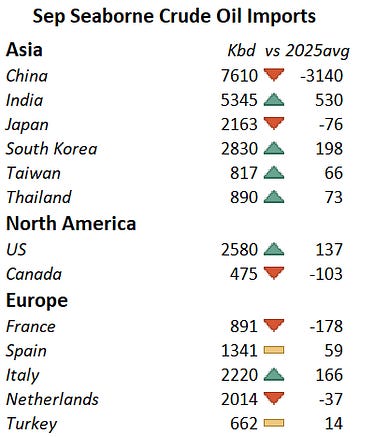
By now, nobody disputes that flows have increased substantially, but still nobody can agree on when we had this kind of flows since. Even the most conservative estimates put September at 7Mnbpd, but still few dare to call Aug loadings (which by my estimates were also in the vicinity of 6Mnbpd) proof of that are the robust Sept import figures (ex-China) show that it is not “Atlantic barrels arriving” in Asia, these barrels are coming from somewhere close.
 |
So, if there is more oil coming out of Hormuz, why haven’t prices come down yet? As you may know, we have different kinds of prices, and even the same thing (same loading place, same loading window) can have 3 different prices depending on when and who you are sourcing from.
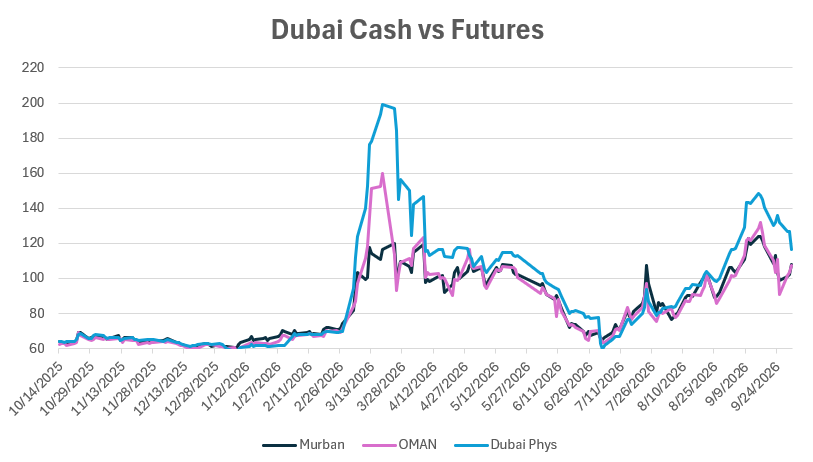 |
Both Murban and Oman futures detached considerably from the “Dubai cash” or Physical premium over the last few weeks, now trading below the cash marker whereas they are supposed to be the same thing, so it might mean there is enough oil in the Gulf of Oman where the two futures have physical delivery mechanisms, is either too much oil or we are having some issues clearing those barrels in a timely fashion. Freight rates both sides of the strait also stalled.
Having said that, the distortion in prices for these barrels is also a consequence of this new marketing method from Middle East exporters (tenders, subterfuge deals, fire sales, etc.), and the funny part is that those indexes don’t even reflect the true value of the crude changing hands, most transactions for Oct/Nov loading are being done at Dubai +5 on average, way lower than the futures indicate. There are some other things at play in the Middle East complex where two of the biggest players in the Dubai market are in a stalemate with contrarian positions, a Chinese and a French, while the rest of the participants just observe… The Dubai market is not a true reflection either.
The same could be said about Brent and WTI, each with opposing forces pushing them apart, resulting in a neutral outcome for the overall oil until they link up…nothing here either….
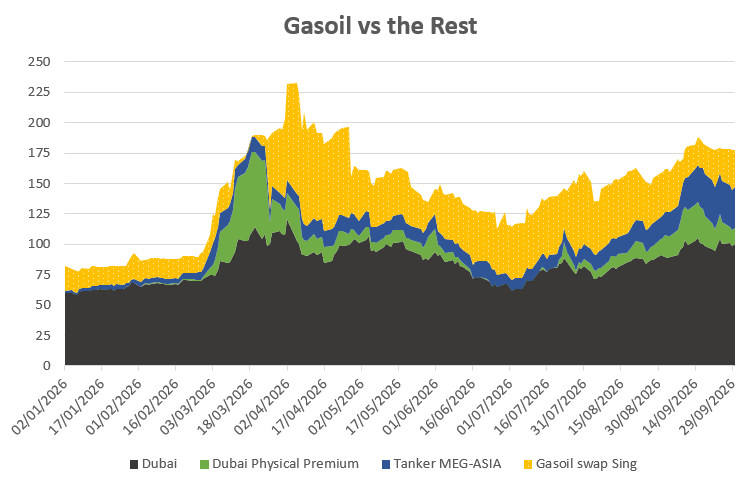
This would explain why oil didn’t move, but does little to answer why 100 and not 80 or 120… The short answer is because Gasoil is at $200. When you have disproportionate outright prices for refined fuels, oil flat price becomes kind of irrelevant.
 |
Now, if you pay attention to who’s selling crude oil in the open markets, you’ll notice the majority of offers come from integrated oil & gas or their trading arms (aka Big Oil), with very few being pure upstream players. The big boys have the 3 different profit centers to attend (Upstream, Midstream & Downstream).
The first half of the year was for the downstream people, but after a bumper quarter for independent refiners, Big Oil is not exactly happy letting them have the cake and eat it too. Why would you let the Reliances, Caltexs of the world capture all the PnL in the market while assuming 1/3 of the risk? Pricing power must reset.
In practice, crude producers are also hedging price exposure using gasoil as a proxy rather than outright crude futures/swaps, alleviating the selling pressure in flat price, channeling profits back to upstream. The “shipping & trading” guys, who are now working more as an “asset-heavy” extension than a pure risk warehouse, are also flexing with daddy’s balance sheet. In the end, it is a return to the status quo.
In a couple of weeks, we are going to put my theory to the test, when we hit the much-delayed refinery maintenance season that, between the US and Europe is looking at 2Mnbpd offline. With less crude buying, we should see crude prices going down while fuels go up, but that might not happen. In times of uncertainty, the market divides into two subsets of prices. Flat price chase flat price (ICE Gasoil/ NYMEX HO, ICE Brent, WTI), meaning they should move in tandem, if diesel goes up, so does oil.
The physical-related price subset (FOB diffs and freight) will be the adjustment variables when the landscape changes; if there is a violent repricing, then maybe we might see a reaction in headline prices. Until then, it is what it is…...
Subscribe to Oil not dead to unlock the rest.
Become a paying subscriber of Oil not dead to get access to this post and other subscriber-only content.
A subscription gets you:
| Oil Weekly Commentary | |
| A custom App and chat | |
| We might start doing webinars |
| ||||||||||


